
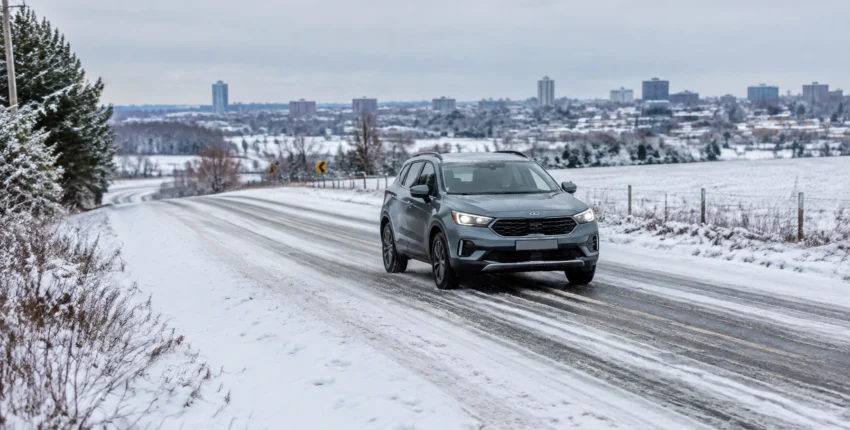
If you drive around Kitchener-Waterloo in winter, you have probably asked the same question as many other Ontario drivers: do you really need dedicated snow tires, or will a good set of all-season tires get you through?
The honest answer is that it depends on your vehicle, your commute, where you park, and how often you drive in snow and freezing conditions. Winter tires are not automatically the right choice for everyone. At the same time, relying on worn or unsuitable all-season tires can leave you with far less traction than you expect.
At MJ’Z Garage Auto Sales in Maryhill, we sell tires and provide tire repair, replacement, rotation, and wheel alignment services. Our goal is not to sell you the most expensive option. It is to help you choose the setup that makes sense for your driving.
Why temperature matters more than the name on the sidewall
Imagine trying to use a rubber eraser outside on a bitterly cold morning. It becomes harder and less flexible. Your tires respond to cold temperatures in a similar way.
Many all-season tires are designed to provide a reasonable balance in mild conditions. However, their rubber compound can become noticeably less flexible as temperatures fall below approximately 7°C. That loss of flexibility affects braking, cornering, and acceleration, even when the pavement is dry.
Winter tires use a cold-weather rubber compound that remains more pliable in low temperatures. Their tread is also designed with additional biting edges, grooves, and sipes to help grip packed snow and clear slush.
The 7°C guideline is not a magic switch that instantly changes your tires overnight. It is a useful reminder that tire performance is affected by temperature before the first major snowfall arrives. Transport Canada provides additional guidance on using winter tires in Canada.
Tread depth and design matter more than marketing claims
A tire can have an impressive name and still be a poor choice if the tread is worn down.
For winter driving, tread depth is especially important. Deeper tread helps channel slush and snow away from the contact patch, while small grooves called sipes create more edges to grip cold surfaces. As the tread wears, the tire loses some of its ability to bite into snow and maintain control.
Before winter, have your tires checked for:
- Remaining tread depth
- Uneven wear across the tread
- Cracks, bulges, or sidewall damage
- Age and signs of rubber deterioration
- Correct size and load rating for your vehicle
- Proper inflation pressure
A tire may still be legally usable and yet provide poor winter performance. As a practical safety benchmark, many Canadian winter-driving resources recommend not using winter tires on snow-covered roads once they are approaching 4 millimetres of tread depth.
The tread pattern matters as well. A tire designed mainly for quiet highway driving may not handle snow as confidently as a tire with deeper grooves and more pronounced winter traction features. Do not judge a tire only by the phrase “all-season” or “all-weather” on its sidewall.
All-season, all-weather, or dedicated winter tires?
These three categories are often confused, but they are not interchangeable.
All-season tires
All-season tires are a reasonable choice for drivers who:
- Drive mostly in mild weather
- Use their vehicle occasionally in winter
- Can avoid driving during major snow or freezing-rain events
- Have a short, well-maintained local commute
- Park their vehicle during the worst conditions
They are not the same as winter tires, and many all-season tires are not certified for severe snow conditions. If you depend on your vehicle every day, especially early in the morning before roads are cleared, all-season tires may be a compromise.
All-weather tires
All-weather tires are a legitimate middle option. They are designed for year-round use and typically carry the Three-Peak Mountain Snowflake symbol, which indicates that they meet a recognized severe-snow performance standard.
Think of all-weather tires as a high-quality multitool. They can work reasonably well in many conditions and may suit drivers who do not want to store and change two sets of tires.
They still represent a compromise. Dedicated winter tires generally provide better grip and braking in consistently cold, snowy, and icy conditions. However, a good set of all-weather tires can be a sensible choice for a driver who wants one set for the entire year.
Dedicated winter tires
Winter tires are the more specialized tool. They are usually the best option if you:
- Drive daily through the winter
- Travel on highways or rural roads
- Leave home early before roads are cleared
- Regularly drive during snowstorms
- Carry children or passengers who depend on your vehicle
- Need dependable braking and steering in cold conditions
- Cannot simply stay home when the weather turns bad
In Kitchener-Waterloo, winter weather can change quickly. A clear morning can become a slippery evening after a temperature drop. Dedicated winter tires give you a larger safety margin when conditions are cold, snowy, or icy.
Your commute should decide more than your neighbour’s opinion
Imagine two drivers living on the same street in Maryhill. One works from home, drives five minutes to nearby errands, and can postpone trips during a storm. The other leaves before sunrise, travels across Kitchener-Waterloo, and must arrive at work regardless of road conditions.
They do not necessarily need the same tire setup.
Ask yourself:
- How many kilometres do you drive in a typical week?
- Do you use highways or rural roads?
- Is your route hilly or shaded, where ice can remain longer?
- Can you avoid driving during heavy snow?
- Do you park outside overnight?
- Is your vehicle used for family transportation or work?
- How quickly are the roads on your route usually cleared?
Kitchener-Waterloo winters are not defined only by deep snow. Freeze-thaw cycles can create black ice, compacted snow, and slush that refreezes after sunset. Even if major roads are plowed quickly, side streets, driveways, bridges, and parking lots may remain slippery.
Your vehicle’s all-wheel-drive system can help it accelerate, but it does not create extra grip when braking or turning. The tires are still the only parts of your vehicle touching the road.
The cost question: two sets versus one
At first glance, one set of all-weather or all-season tires can appear less expensive than buying dedicated winter tires and a second set of wheels. But cost should be considered over several seasons.
With two tire sets, each set is used for only part of the year. That can reduce the rate at which either set wears. You will also pay for seasonal installation, balancing, and storage if you do not have a place to keep the unused tires.
With one year-round set, you avoid seasonal changeovers and storage. However, those tires remain on the vehicle through every season and may wear faster. If they are used during hot summer driving and cold winter driving, replacement may arrive sooner than expected.
Insurance can also affect the calculation. Many Ontario insurers offer a discount for qualifying winter tires, but the amount and conditions vary. Ask your insurer:
- Whether four winter tires are required
- Whether 3PMSF-rated all-weather tires qualify
- Which installation and removal dates apply
- Whether receipts or proof of installation are required
Never assume that a particular tire automatically qualifies. Confirm the details before counting a discount in your budget.
What to look for when buying winter tires
You do not necessarily need the most expensive tire in the shop. You do need the correct tire for your vehicle and driving conditions.
Before purchasing, check:
Correct fitment
The tire must match your vehicle’s required size, load rating, speed rating, and clearance. A tire that fits the wheel may still be unsuitable for the vehicle.
Four matching tires
Install winter tires as a complete set of four. Putting winter tires only on the front or rear can create an imbalance in traction and handling. When the front and rear tires respond differently, your vehicle may not behave predictably during emergency manoeuvres.
Date code and condition
Newer is generally preferable, but age is not the only factor. A properly stored tire may be in better condition than an older tire that has spent years exposed to sunlight, heat, and weather.
Tread suitable for your route
A driver who stays in town may need a different tread balance than someone who regularly travels rural roads or highways. Ask about traction, noise, ride comfort, and expected mileage rather than focusing on brand reputation alone.
Do not forget rotation, alignment, and storage

A good tire cannot compensate for a vehicle that is out of alignment or has worn suspension components.
Uneven wear may point to incorrect alignment, poor tire pressure, worn steering parts, or suspension problems. If you install new tires without addressing the cause of the wear, you may shorten their life and lose traction sooner than expected.
Have your tires inspected during seasonal changeover. Ask for rotation when appropriate, and make sure the tires are inflated to the vehicle manufacturer’s recommended pressure. Store the unused set in a cool, dry place away from direct sunlight and chemicals. If you do not have suitable storage, ask about available tire-storage options when you book service.
At an auto repair shop in Maryhill, ON, a tire inspection can also reveal related maintenance concerns. A simple check may identify alignment wear, a slow leak, or a brake issue before it becomes a more expensive problem.
How to avoid being upsold
A trustworthy tire recommendation should begin with questions, not pressure.
Be cautious if someone immediately recommends the most expensive winter tire without asking about your driving habits. You should receive a clear explanation of why a tire is suitable, what its limitations are, how long it may last, and what the complete cost will be.
At MJ’Z Garage, we will explain your options honestly. If quality all-season or all-weather tires are enough for your situation, we will not push you into dedicated winter tires simply because the season is approaching.
Likewise, if your current tires are worn, damaged, or poorly suited to your daily commute, we will tell you directly. Safety comes first, but so does giving you useful advice that respects your budget.
The honest recommendation for Kitchener-Waterloo drivers
For frequent winter driving, long commutes, highway travel, and situations where you cannot avoid bad weather, dedicated winter tires are usually the strongest choice.
For drivers who want one set of tires year-round, quality all-weather tires with the Three-Peak Mountain Snowflake symbol can be a practical middle ground.
For occasional local driving with the flexibility to stay off the roads during severe conditions, good-condition all-season tires may be adequate: but only if they have sufficient tread and your driving habits truly match that choice.
If you are due for an oil change in Maryhill, tire inspection, or seasonal maintenance visit, it is a convenient time to review your complete winter setup. Drivers searching for car maintenance near me often start with a single service, but a careful inspection can help prevent several cold-weather problems at once.
Do not wait for the first major snowfall to find out that your tires are worn or unsuitable. Contact MJ’Z Garage Auto Sales at 9 St Charles St E in Maryhill to book a free consultation or winter tire inspection. We serve drivers throughout Maryhill and the Kitchener-Waterloo area with tire repair, replacement, rotation, wheel alignment, and honest automotive advice.