We’ve all been there. You’re driving down a quiet road in Maryhill, maybe heading home after a long day, and you tap the brake pedal to slow down for a turn. Then you hear it, a high-pitched, metallic squeal that sets your teeth on edge. Your first thought probably isn’t “I should call my mechanic”; it’s more likely, “How much is this going to cost me?”
At MJ’Z Garage Auto Sales, we understand that “brake repair” are two words that most drivers dread hearing. There’s a common fear that as soon as you walk into a shop, you’re going to be told you need an entirely new system, from the pads to the rotors and everything in between. But here’s the thing: at our shop, we believe in honesty above all else. Not every noise means a total overhaul, but every noise does tell a story.
If you’ve been searching for brake repair near me, you deserve to know the truth about your stopping power. Let’s pull back the curtain on what’s actually happening when you hit that pedal and how to tell if you’re looking at a quick fix or a necessary safety intervention.
The Unsung Heroes of Your Commute
Think of your braking system as the silent guardian of your vehicle. While the engine gets all the glory for “powering” your ride, your brakes are the ones doing the heavy lifting to keep you out of trouble. In a place like Maryhill, ON, where we deal with everything from icy winter patches to sudden stops for local wildlife, your brakes aren’t just a convenience, they are your primary safety feature.
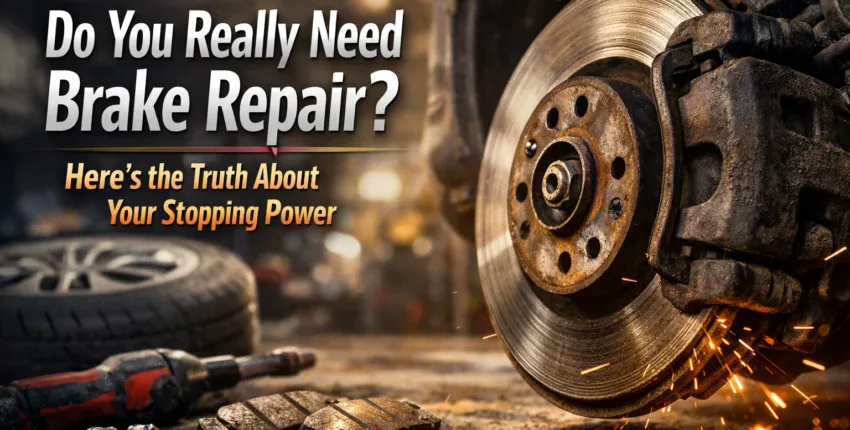
A standard disc brake system is actually quite simple, but it relies on several components working in perfect harmony:
- The Pads: These are the “sacrificial” parts. They are designed to wear down over time as they provide the friction needed to stop your wheels.
- The Rotors (Discs): These are the metal plates the pads squeeze against.
- The Calipers: The hydraulic clamps that push the pads into the rotors.
- The Fluid: The “lifeblood” that transfers the pressure from your foot to the wheels.
When one of these starts to fail, the symptoms are usually hard to ignore.

5 Warning Signs You Can’t Ignore
We get asked all the time: “Do I really need to bring it in yet?” While we aren’t about upselling you on things you don’t need, we are very serious about safety. If you experience any of the following, it’s time to consult a professional mechanic Maryhill can trust.
1. That Piercing Squeal
Most modern brake pads are built with a tiny metal shim called a “wear indicator.” When the pad gets thin enough, this shim touches the rotor and creates that annoying squealing sound. It’s literally your car’s way of saying, “Hey, I’m getting low!” If you catch it at this stage, you’re usually just looking at a straightforward pad replacement: a much cheaper job than waiting until things get worse.
2. The Dreaded Grinding
If the squeal has turned into a deep, metallic grinding or growling, you’ve entered the “danger zone.” This usually means the friction material on your pads is completely gone, and you’re now pressing metal against metal. This doesn’t just reduce your stopping power; it destroys your rotors. For more details on what these sounds mean, check out our guide on squeaky wheels and what to expect.
3. Vibrations and Pulsing
Does your steering wheel shake or your brake pedal “flutter” when you try to slow down from highway speeds? This is often a sign of warped rotors. Rotors can warp due to extreme heat or if they’ve been worn too thin. It’s not just an annoyance; it creates an uneven braking surface that can increase your stopping distance significantly.
4. The Spongy Pedal
If you have to press the brake pedal almost to the floor before the car starts to slow down, or if the pedal feels “mushy” like you’re stepping on a sponge, you have a hydraulic issue. This could be air in the brake lines or, more seriously, a brake fluid leak. Since brake fluid is essential for the system to function, this is a “park the car and call us” kind of situation.
5. Pulling to One Side
If your car seems to want to take a sharp turn every time you brake, you might have a stuck caliper or a collapsed brake hose. This uneven braking is incredibly dangerous, especially on wet or slippery roads.

Why Honesty Matters in Brake Repair
We know the reputation the auto industry has. You go in for an oil change and leave with a $2,000 quote for “suggested repairs.” At MJ’Z Garage Auto Sales, our “Honest” brand tone isn’t just a marketing slogan: it’s how we do business.
When you bring your vehicle in for auto repair Maryhill ON, we perform a transparent inspection. If your pads have 40% life left, we’ll tell you. We won’t pressure you to change them today just to pad the bill. We’ll give you an honest estimate of how many kilometers you have left and let you plan for it.
Our goal is to be your long-term partner in vehicle health. We want you to feel confident that when we say “you need to fix this,” we mean it for the sake of your safety and your wallet. Investing in regular brakes repair is actually a cost-saving measure in the long run.
The Real Cost of Waiting
It’s tempting to turn up the radio and ignore that little squeak for a few more months. However, the anatomy of a brake system means that neglect leads to a “snowball effect.”
Imagine your brake pads are worn down. Replacing them is a standard, affordable maintenance task. But if you keep driving, those worn pads will start to gouge your rotors. Now, instead of just a pad swap, you need new rotors too. If the heat from that metal-on-metal friction gets intense enough, it can damage your calipers or even boil your brake fluid.
What could have been a $200 maintenance stop quickly turns into a $1,000+ repair. Beyond the money, there is the literal “stopping power” truth: worn brakes take longer to stop. In an emergency, those extra three or four meters can be the difference between a close call and a collision.

Common Brake Myths Debunked
To help you stay informed, let’s clear up a few things we hear often at the shop:
- Myth: Brake fluid lasts forever.
- Truth: Brake fluid is “hygroscopic,” meaning it absorbs moisture from the air over time. This moisture can cause internal corrosion and lower the boiling point of the fluid. We recommend checking your fluid regularly. You can read more about why auto fluid maintenance matters here.
- Myth: All brake pads are the same.
- Truth: There are ceramic, semi-metallic, and organic pads. Depending on how you drive (towing, city driving, or highway commuting), the type of pad you choose matters for both performance and noise levels.
- Myth: If the light isn’t on, the brakes are fine.
- Truth: Not every car has a sensor for pad thickness. Your ears and the “feel” of the pedal are often better indicators than the dashboard.
Your Safety Is Our Priority
When it comes to brake repair near me, you have choices. But if you want a team that values your safety as much as you do, MJ’Z Garage is here for the Maryhill community. We treat every vehicle that enters our bays as if our own family were going to be driving it.
Whether you need a simple inspection, a fluid flush, or a complete pad and rotor replacement, we provide a comprehensive guide to keeping your car safe through our expert service.
Don’t wait for the “grind” to tell you there’s a problem. If something feels off, sounds off, or just doesn’t stop like it used to, give us a shout. We’ll give you the honest truth about your stopping power and get you back on the road with total peace of mind.

Ready for a Check-Up?
If you’re in Maryhill or the surrounding area and noticed any of the signs we mentioned, don’t leave it to chance. Stop by MJ’Z Garage Auto Sales for a transparent, no-pressure inspection. We’re here to make sure your “stopping power” is exactly where it needs to be.