A used car can look like a bargain in an online listing and still become expensive within weeks. A low asking price may hide worn brakes, overdue maintenance, accident repairs, high insurance costs, or financing terms that stretch your budget much further than expected.
That does not mean buying used is a gamble. It means you need to look beyond the shine and the monthly payment.
If you are comparing used cars in Kitchener, Waterloo, Cambridge, or Maryhill, use this checklist before you sign anything. A good deal should make sense mechanically, financially, and practically: not just look attractive on a dealership lot.
1. Calculate the real cost, not just the advertised price
Imagine finding a vehicle listed at a price that fits your budget perfectly. Then you add tax, licensing, insurance, financing costs, and the first round of maintenance. Suddenly, the “deal” is much more expensive than expected.
Before you get attached to a particular car, work out the complete cost of ownership. Consider:
- The purchase price
- HST and registration costs
- Licensing and plate fees
- Insurance
- Financing interest
- Immediate maintenance or repairs
- Winter tires or other necessary equipment
Ask for the total price in writing. If you are financing, compare the total amount you will repay: not only the monthly payment. A longer loan term can make the payment look manageable while adding substantially to the overall cost.
You can also compare similar vehicles in the Kitchener-Waterloo market. Look at the same model year, approximate kilometres, trim level, drivetrain, and condition. A vehicle priced higher than comparable listings should offer a clear reason, such as documented maintenance, newer tires, or meaningful equipment.
2. Match the vehicle history to the car in front of you
A vehicle history report is useful, but it is not a substitute for careful inspection. Start by checking the vehicle identification number, or VIN, in several places:
- The dashboard near the windshield
- The driver’s door jamb
- The ownership documents
- The vehicle history report
- Any Ontario paperwork provided with the vehicle
The numbers should match exactly. Even a small discrepancy deserves an explanation before you continue.
Review the history for reported collisions, insurance claims, registration changes, odometer concerns, theft or rebuild branding, and service records. A previous accident does not automatically make a car a bad purchase. The important questions are how serious the damage was, who repaired it, and whether the work was completed properly.
If you are buying privately in Ontario, ask for the Used Vehicle Information Package. The seller is generally responsible for providing it, and it contains important information about the vehicle’s registration history, lien status, and other details.
Never assume that a clean-looking vehicle has a clean history. Paint and polishing can hide a great deal.
3. Get an independent mechanical inspection
A test drive can tell you how a vehicle feels. It cannot reliably tell you what is happening inside the engine, transmission, suspension, or braking system.
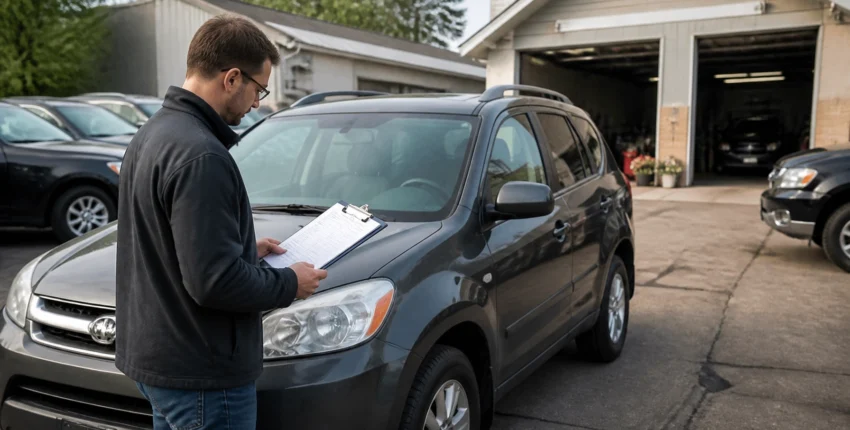
A pre-purchase inspection is one of the most effective ways to protect both your safety and your budget. A qualified technician may identify problems such as:
- Oil or coolant leaks
- Worn brake pads, rotors, or calipers
- Uneven tire wear
- Loose steering or suspension components
- Rust near structural areas
- Transmission concerns
- Weak battery or charging-system problems
- Diagnostic trouble codes
- Signs of previous collision repairs
A Safety Standards Certificate is important when registering a used vehicle in Ontario, but it should not be treated as a full condition report or warranty. It confirms that the vehicle met specific minimum safety requirements at the time of inspection. It does not tell you that every system is in excellent condition or that future repairs will not be needed.
For a closer look at what an inspection can uncover, read our guide to why a pre-purchase inspection matters when buying a used vehicle.

4. Look closely for rust, poor repairs, and uneven wear
Ontario winters are hard on vehicles. Road salt, moisture, freezing temperatures, and potholes can gradually damage a car even when the body still looks presentable.
Inspect the vehicle in daylight if possible. Walk around it slowly and compare one side with the other. Look for:
- Paint that does not match from panel to panel
- Overspray on trim, glass, or rubber seals
- Uneven gaps around doors, the hood, or trunk
- Ripples in body panels
- Rust around wheel arches and rocker panels
- Bubbling paint along door edges
- Corrosion underneath the vehicle
- Cracked lights or damaged glass
- Fresh undercoating that may be hiding older rust
Pay particular attention to the tires. Uneven wear on the inside or outside edge can point to alignment problems, worn suspension parts, or previous impact damage. If the tires are nearly worn out, include replacement costs in your offer and budget.
Some cosmetic imperfections are normal in a used vehicle. Structural rust, poor collision repairs, or evidence of serious neglect deserve much more caution.
5. Test every feature you will depend on
Many buyers focus on the engine and forget the systems they use every day. A faulty power window may not make the car unsafe by itself, but a failed defroster, warning light, or backup camera can become a serious inconvenience: or a safety concern.
Before buying, test the vehicle with the engine running and check:
- Headlights, brake lights, turn signals, and hazards
- Windshield wipers and washer fluid spray
- Horn and seatbelts
- Windows, locks, and mirrors
- Heater, air conditioning, and defroster
- Dashboard warning lights
- Backup camera and parking sensors
- Audio system, Bluetooth, and navigation
- Sunroof or power liftgate, if equipped
Watch the instrument panel when you start the car. Warning lights should illuminate briefly as part of the system check and then turn off. A check-engine, ABS, airbag, or charging-system light that stays on should be investigated before you commit.
Also pay attention to smells. A strong mould odour may suggest water intrusion. Heavy air freshener or perfume can sometimes be used to cover smoke, dampness, or other odours.
6. Take a quiet, complete test drive
A quick trip around the block is not enough to judge a used car. Ask to drive through a mix of city streets and, when appropriate, higher-speed roads. Turn the radio off and listen.
During the drive, consider the following:
Braking
The brake pedal should feel firm and predictable. The vehicle should stop in a straight line without pulling, grinding, pulsation, or unusual vibration.
Steering and suspension
The car should track straight without constant correction. Pay attention to clunks over bumps, steering-wheel vibration, excessive bouncing, or a feeling that the vehicle is floating.
Engine and transmission
The engine should start without excessive smoke, knocking, or prolonged rattling. Automatic transmissions should shift without harsh engagement or slipping. On a manual vehicle, the clutch should engage smoothly without an engine flare in the revs.
Temperature and warning signs
Watch the temperature gauge during the drive. Notice whether the vehicle overheats, idles roughly, or develops a warning light once it reaches operating temperature.
If the seller will not allow a proper test drive, or if you feel rushed into making a decision, treat that as information. You should have enough time to decide whether the vehicle feels safe and suitable.
7. Read the paperwork and financing terms carefully
A good vehicle can still be a poor deal if the paperwork is unclear.
Confirm that the VIN, mileage, selling price, and vehicle description are correct. Ask what is included in the deal and what is not. If a warranty, service contract, safety certification, or repair is mentioned verbally, request the details in writing.
When reviewing financing, look at:
- Interest rate
- Loan term
- Monthly payment
- Total amount financed
- Total amount repayable
- Any administration fees
- Optional warranties or protection products
- Whether add-ons are included in the payment
MJ’Z Garage Auto Sales offers financing options designed for everyday local buyers, including options with no credit check or income verification. Even so, you should still understand the full agreement before accepting it. Financing can help make a dependable vehicle accessible, but the payment must fit comfortably alongside insurance, fuel, maintenance, and household expenses.
It is also wise to contact your insurer with the vehicle’s VIN before finalizing the purchase. Two vehicles with similar prices can have very different insurance costs.
What makes a used car a genuinely good deal?
A good deal is not necessarily the cheapest vehicle you can find. It is a vehicle whose condition, history, price, and future running costs make sense together.
The right car may have a few ordinary cosmetic marks but strong maintenance records and a sound inspection. Another vehicle may look flawless but need major work underneath. Your goal is to understand what you are buying so you can make a decision without pressure.
At MJ’Z Garage Auto Sales, we are a family-owned auto sales and repair centre serving Maryhill and the Kitchener-Waterloo area. Our repair experience gives buyers a practical way to evaluate the mechanical condition of a used vehicle, and our approach is straightforward: explain what we know, provide honest pricing, and avoid pushing you toward something you do not need.
If you are looking at used cars in Kitchener or searching for a used car dealership in Maryhill, Ontario, contact us or visit our about page to learn more. You can also get in touch with MJ’Z Garage to discuss a vehicle, financing options, or your next step before you sign.