
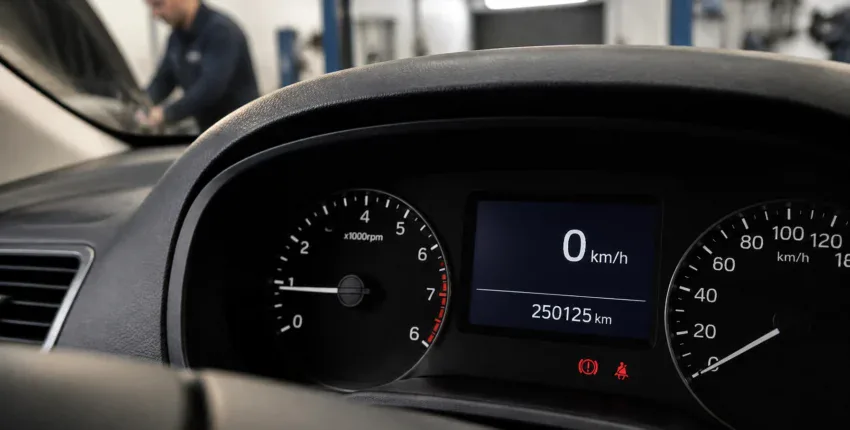
Imagine you’re driving down the highway, and you glance down at your dashboard. The odometer flickers, rolling over that big 200,000 or 250,000-kilometer milestone. For some, it’s a badge of honor: a testament to a reliable machine that’s been through every Ontario winter and summer road trip. For others, it’s a ticking time bomb. You start to wonder: Is the next strange sound going to be the one that costs more than the car is worth?
The dilemma of the high-mileage vehicle is something we see every day at MJ’Z Garage Auto Sales. It’s a delicate balance between financial wisdom and the “sunk cost fallacy.” Many drivers fear that once a car hits a certain age, every dollar spent on repairs is a dollar wasted. But the truth is often the opposite. In today’s economy, where new car prices are soaring and financing rates are hovering around 7% for new models, keeping your current ride on the road is frequently the smartest financial move you can make: provided you have a plan.
The Financial Reality: Repairs vs. Monthly Payments
Let’s talk numbers, because that’s usually where the decision to keep or trade begins. When you search for “car maintenance near me,” you’re often looking for a quick fix, but you should also be thinking about your long-term budget.
A typical new car payment in 2026 can easily range from $500 to $800 a month. Over a year, that’s $6,000 to $9,600. Now, compare that to the maintenance of a high-mileage vehicle. Even if you have a “bad year” where you need a major repair: say, a new set of tires, a brake overhaul, and some suspension work: you might spend $2,500. While that $2,500 bill feels heavy in the moment, it is still significantly less than the $7,000+ you would have spent on monthly payments for a newer vehicle.
Furthermore, high-mileage cars have already suffered their biggest hit in depreciation. A new car loses 20-30% of its value the moment you drive it off the lot. Your 10-year-old SUV? It’s already done its losing. Every kilometer you squeeze out of it now is essentially “free” transportation once the loan is paid off. The key is knowing which repairs are investments in longevity and which are just delaying the inevitable.
The Secret to the 300,000-Kilometer Club
What separates the cars that make it to 300,000 or 400,000 kilometers from the ones that end up in the scrap yard at 180,000? It isn’t just luck; it’s the secret to a long-lasting car through disciplined, proactive care.
As a car ages, its needs change. It’s no longer just about the occasional oil change. You have to start looking at the “hidden” systems that keep the vehicle stable and efficient.
1. Fluid Lifeblood
Fresh fluids are the single most important factor in vehicle longevity. Over time, engine coolant becomes acidic, brake fluid absorbs moisture, and transmission fluid loses its ability to lubricate and cool moving parts. For drivers in Maryhill and the surrounding Kitchener area, our harsh winters make this even more critical. Cold starts and salted roads put immense stress on these systems. Staying on top of an oil change and general fluid maintenance ensures that small friction issues don’t turn into catastrophic engine or transmission failures.
2. The Rubber and Seals
Age is often harder on a car than kilometers. Rubber components: hoses, belts, and bushings: dry out and crack over time. A $100 coolant hose that bursts on the highway can lead to a $4,000 engine rebuild if the car overheats. This is why a regular inspection by a professional mechanic Maryhill residents trust is so vital. We look for the small cracks in the serpentine belt or the slight bulge in a radiator hose before they leave you stranded.

When “That Noise” Becomes a Warning
Imagine you’re pulling out of your driveway and you hear a faint rhythmic clicking or a low hum that wasn’t there last week. In a high-mileage car, it’s easy to turn up the radio and ignore it. But in the world of automotive repair, “ignoring it” is the most expensive thing you can do.
Unusual noises are your car’s way of asking for help. A hum might be a wheel bearing that’s about to seize; a click might be a CV axle that’s lost its grease. Using advanced vehicle diagnostics allows us to pinpoint exactly where the wear is happening.
For high-mileage owners, the goal is “surgical” maintenance. You don’t want to replace everything, but you must replace the right things. If your suspension is starting to feel “sloppy,” it’s not just a comfort issue: it’s a safety issue. Worn shocks and struts increase your braking distance and make the car harder to control in an emergency swerve.
The Safety Threshold: Is it Still Safe for Your Family?
This is where we get serious. There is a point where a high-mileage car is no longer worth the investment, and that point is usually defined by safety.
If the frame of the vehicle has significant structural rust (a common problem throughout Ontario), no amount of engine work will make it safe. Similarly, if the brake system is compromised by rusted lines or failing calipers, that’s a non-negotiable repair.
We often tell our customers: “If you wouldn’t feel comfortable sending your teenager off to college in this car, it’s time to evaluate its future.” A car that is mechanically sound but has high kilometers is a tool. A car that is structurally failing is a liability.
The MJ’Z Garage Philosophy: Honesty Over Upselling
One of the biggest fears people have when looking for “car maintenance near me” is that a shop will take advantage of their high-mileage situation. They worry a mechanic will see an old car and start listing off thousands of dollars in “necessary” repairs that the car doesn’t actually need to stay on the road.
At MJ’Z Garage Auto Sales, we operate differently. Our 20+ years of experience has taught us that honesty is the best business model. When you bring in a high-mileage vehicle, we provide a transparent assessment. We’ll tell you, “Your valve cover gasket is seeping a little bit of oil. It’s messy, but it’s not an emergency. However, your front ball joints are dangerously loose and need to be fixed today.”
We categorize repairs into three buckets:
- Safety Critical: Must be done to keep the car on the road and keep you safe.
- Longevity Critical: Repairs that prevent much more expensive failures down the road.
- Cosmetic/Convenience: Things that are “nice to have” but won’t stop the car from running.
This approach helps you manage your budget and decide if the investment is worth it. If we see a repair coming that will cost more than the car’s market value, we’ll be the first ones to tell you it might be time to look at a quality used replacement from our sales center.
Conclusion: Value is Found in the Long Run
A high-mileage car isn’t a burden; it’s an opportunity to save thousands of dollars in interest and depreciation. Modern vehicles are engineered to last much longer than the cars of thirty years ago. With the right care, 300,000 kilometers is just the middle of a vehicle’s life, not the end.
The truth about high-mileage maintenance is that it requires a partnership between you and a technician you can trust. By being proactive, listening to your vehicle, and prioritizing safety, you can keep your car on the road for years to come without the weight of a monthly car payment.
Are you worried about a new noise or wondering if your high-mileage vehicle is still safe for the road? Don’t leave it to chance. Bring your vehicle to the experts who value integrity as much as you do. Contact MJ’Z Garage Auto Sales today for a comprehensive inspection and let our family-owned team give you the honest advice you deserve. We’re here to help you stay on the road safely and affordably.